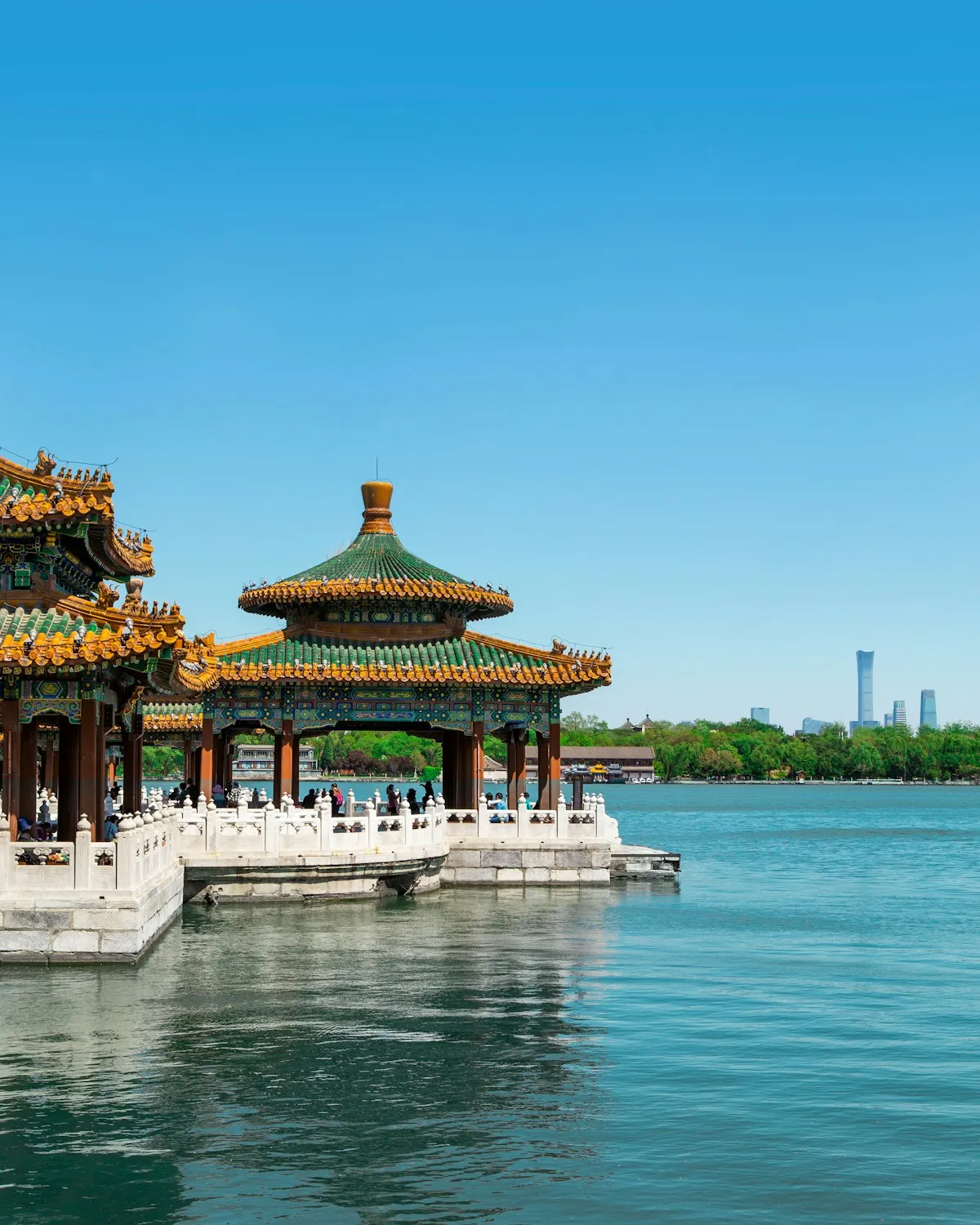
Yiheyuan · Beijing · 1750 (rebuilt 1886)
The Summer Palace is China's largest imperial garden — a 290-hectare composition of lake, hill, pavilions, and corridors laid out by the Qianlong Emperor in 1750 and rebuilt by Empress Dowager Cixi in 1886 with funds earmarked for the imperial navy. Its centerpiece, the 728-meter Long Corridor, is the world's longest painted gallery, carrying more than 14,000 scenes across its beams. The garden is a living textbook of Chinese landscape technique: a lake excavated to raise a hill, islands placed by design, and distant pagodas 'borrowed' into the composition from beyond the garden wall.
The garden's entire landscape was manufactured in one act of earth-moving. In 1750 the Qianlong Emperor ordered the excavation of a lake on the site of a smaller reservoir, and the excavated earth was piled into a new hill on its northern shore — Wanshou Shan (Longevity Hill), named to celebrate his mother's 60th birthday. The result is a controlled landscape where water occupies roughly three quarters of the 290-hectare site, every promontory and island placed by design.
Qianlong modeled the lake on West Lake in Hangzhou, which he had toured during southern inspection trips. The western dike with its six bridges copies the Su Causeway, while the 150-meter Seventeen-Arch Bridge links the eastern shore to Nanhu Island, whose temple sits in the water to mirror the hilltop temples on the far shore. Nothing is accidental: the lake's long axis points directly at the Jade Spring Hill pagoda beyond the garden wall, a composition technique called jiejing ('borrowed scenery') that pulls distant landmarks into the garden picture.
The Long Corridor (Changlang) runs 728 meters along the northern shore of Kunming Lake, connecting the eastern and western garden zones. It is divided into 273 bays by 548 columns and topped with more than 14,000 painted scenes — landscapes, flowers, birds, and episodes from novels such as Journey to the West and Romance of the Three Kingdoms — applied to the beams in the exacting caihua tradition of mineral-pigment painting.
Built in 1750 and restored after the 1860 destruction, the corridor is the longest painted gallery in the world. Its function was practical as well as ceremonial: it sheltered the imperial household from sun and rain on the mile-long walk between the residence halls and the lakefront, while its 273 identical bays give the shore a rhythm of light and shadow that changes with every hour of the day.
The Marble Boat (Shifang) is a 36-meter pavilion built on a stone hull at the lake's northwestern corner. The original 1755 version was a simple waterside pavilion, but after the Anglo-French destruction of 1860 the Empress Dowager Cixi rebuilt it in 1893 with a superstructure of painted wood and two paddle-wheel forms at the stern — a deliberate nod to the Western steamships that had humiliated the Qing navy.
The boat carries a deliberate political message: a stone vessel that can never sink symbolizes the permanence of the dynasty, while its location — moored just outside the imperial apartments — turned every stroll along the shore into a quiet reminder of power. Its construction from palace funds during the same years the real navy was underfunded made it the most famous symbol of Qing extravagance in China.
The garden's visual spine is a single axis running north-south from the lakefront through the Hall of Dispelling Clouds (Paiyundian), past the Pavilion of Buddhist Fragrance, and up to the Sea of Wisdom temple at the hill's crest. The Pavilion of Buddhist Fragrance (Foxiangge) — an octagonal, three-story tower 41 meters tall — rises above the trees as the highest point in the garden, visible from almost every vantage across the lake.
Below the tower, terraced courtyards ascend the hillside in the same layered progression used in temple architecture, each platform framing the one above. The composition is complete only when the eye travels beyond the garden walls: the distant Jade Spring Hill pagoda and the Western Hills align with the lake's open water, so the borrowed scenery becomes the final, most important element of the design — proof that Chinese garden art treats the entire landscape, not the garden wall, as its canvas.
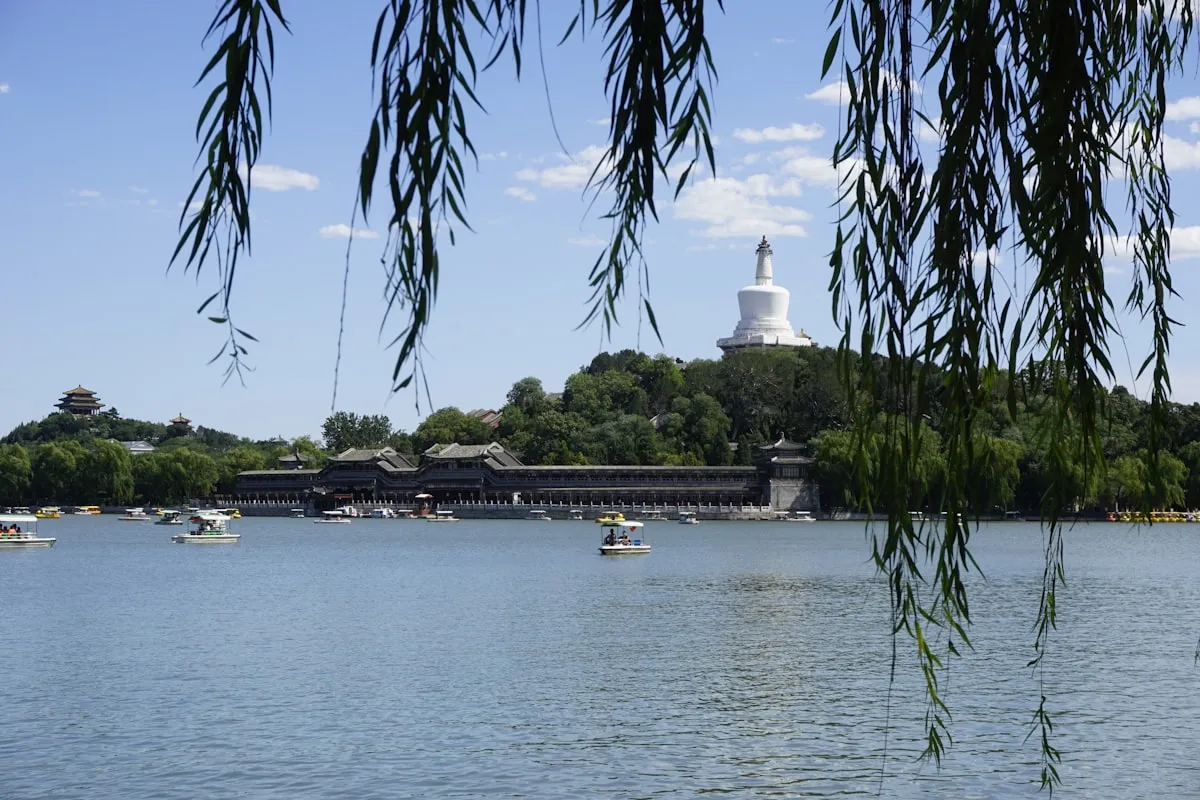
Best Time to Visit
Summer for lush gardens and lotus; winter for snow-dusted pavilions
Photography Tips
Long Corridor for framed compositions; sunset behind 17-Arch Bridge on Kunming Lake
How to Get There
Subway Line 4 to Beigongmen; enter from East Gate for dramatic first view
Originally named Qingyi Garden (Garden of Clear Ripples), it served as the imperial summer retreat — the royal family moved here from the Forbidden City during the hottest months. The name was changed to Yiheyuan, usually translated as Summer Palace, after Cixi's 1886-1895 rebuilding.
Legend holds that Cixi rebuilt the palace using the 30 million taels earmarked for the Beiyang Fleet — and the Marble Boat, a stone pavilion shaped like a paddle steamer, became the symbol of that extravagance. Historians debate the exact sums, but the navy was undeniably weakened before the 1894-95 defeat by Japan.
The covered walkway runs 728 meters along Kunming Lake — the longest painted corridor in the world. Its 273 sections carry more than 14,000 paintings: landscapes, legends, flowers, and scenes from the Romance of the Three Kingdoms and Journey to the West.