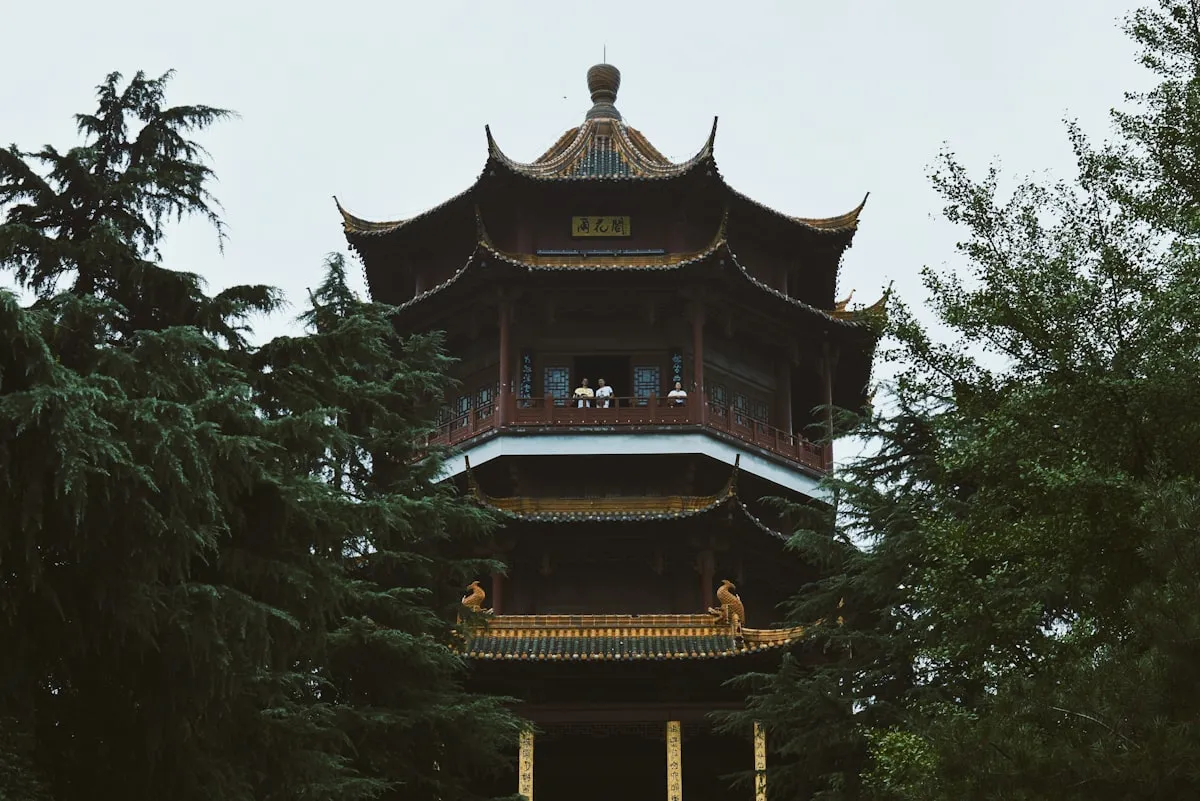
Yingxian Muta · Shanxi Province · 1056 CE
The Yingxian Pagoda is the oldest and tallest surviving all-wood pagoda in the world. Standing 67 meters tall with no metal fasteners, it was built during the Liao dynasty. Its 54 different types of dougong brackets — more variety than any other building — make it a living encyclopedia of Chinese bracket construction. Despite surviving 40 earthquakes and numerous wars, the pagoda stands today as a testament to the genius of Chinese wooden architecture.
The pagoda rises 67 meters on an octagonal plan 30 meters across at the base, making it the tallest wooden building in China and the oldest surviving all-wood pagoda in the world. The octagon is not decorative: compared with a square plan, it shortens the span of every beam and presents the same face to winds from any direction, distributing lateral forces evenly around the ring.
Inside, the five visible stories conceal four hidden structural levels whose diagonal braces form rigid rings at every floor line. An outer ring of columns and an inner ring create a double-tube frame, so each story behaves like a huge horizontal wheel. During an earthquake the interlocking joints — more than 10,000 structural members fitted without a single nail — flex and grind instead of snapping. The pagoda has survived more than 40 recorded earthquakes in 970 years.
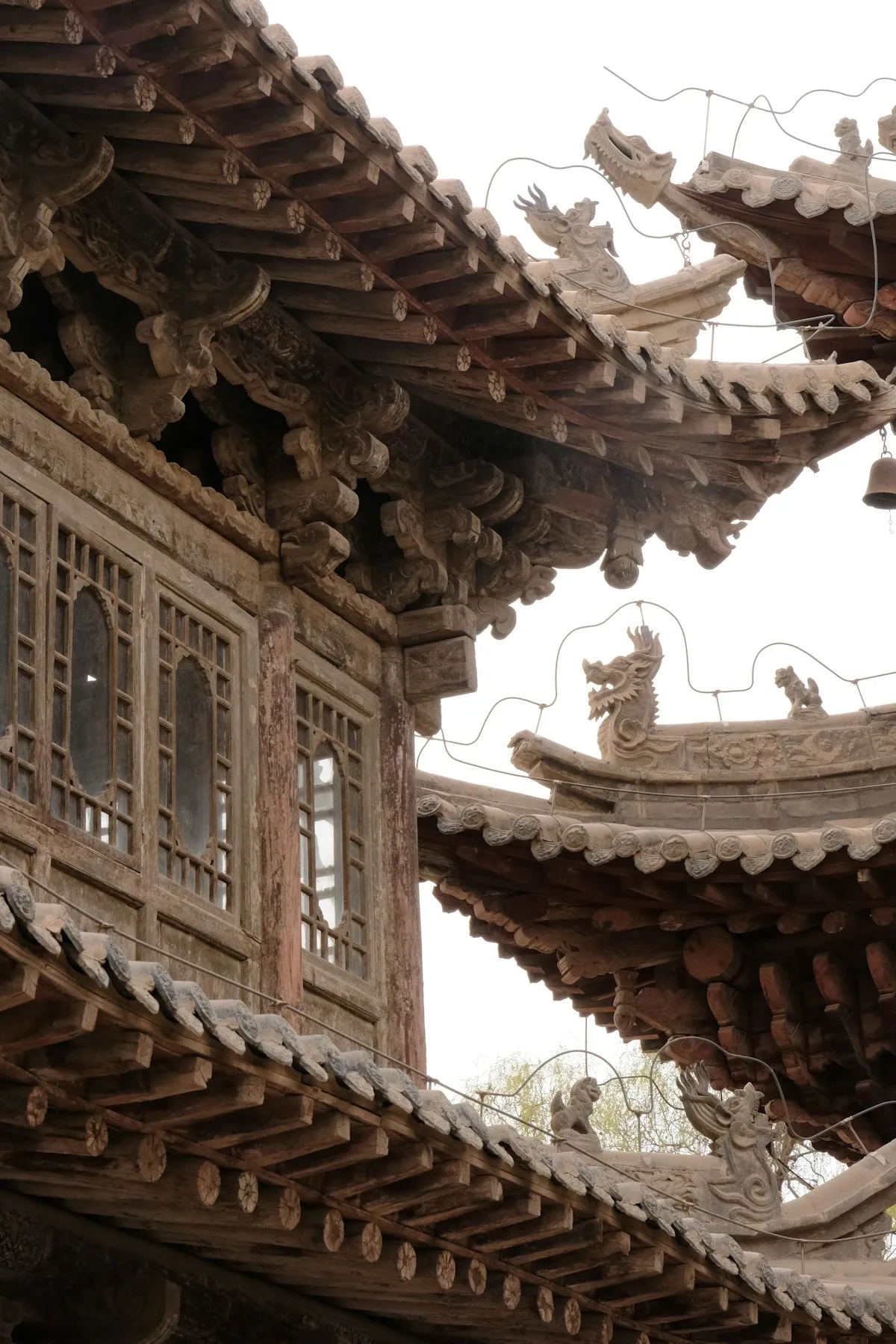
No other building in China displays so many bracket systems: 54 distinct dougong types applied at column tops, under the eaves, at the corners, and around the hidden structural levels. Each type solves a specific problem — some carry the deep eaves of the lowest story, others transfer the weight of the upper walls onto the inner column ring, and still others brace the corners where two roof planes meet.
Architectural historians use the pagoda as a living reference for Liao dynasty practice: nearly every bracket type can be matched to a clause in the Yingzao Fashi, the 1103 building manual, yet several variations appear nowhere else in China. Because the pagoda preserves its original 11th-century members, it shows exactly how those written rules were executed — the brackets' proportions, their relation to column height, and the graceful way they step outward story by story.
Built in 1056 CE during the Liao dynasty, the Yingxian Pagoda was commissioned by Emperor Daozong as part of a Buddhist temple complex honoring his father. The Liao, a Khitan-ruled dynasty that controlled northern China, were devout Buddhists who invested heavily in temple construction — and they had the forests to do it: the pine woods of Shanxi supplied timber of exceptional length and straightness, which is why Liao builders could raise members that later dynasties could not match.
Records show the pagoda was completed in 1056, only 13 years after the founding of the temple, and survived its first documented earthquake by 1195. When the architect Liang Sicheng surveyed it in 1933, he wrote that the pagoda was the greatest wooden structure he had ever seen — the same judgment he had passed on the 857 CE East Hall at Foguang Temple. The pagoda's location in Yingxian County, near the strategic Yanmenguan Pass, placed it at the intersection of Han Chinese and nomadic cultures — a context reflected in its architectural synthesis of Chinese timber techniques with Liao Buddhist patronage.
Despite surviving 40 major earthquakes, the pagoda faces significant conservation challenges. The structure has developed a noticeable tilt — leaning approximately 3 degrees from vertical at its upper levels — caused by uneven foundation settlement and centuries of wind load from the northwest. Since the 1990s, Chinese heritage authorities have undertaken extensive studies to stabilize the pagoda without disassembling it, a delicate process given the nail-free construction. The pagoda is not currently open for interior visits, but the exterior and the surrounding temple complex are accessible to the public.
Best Time to Visit
Spring for blooming apricot trees; autumn for golden ginkgo leaves
Photography Tips
Best exterior from southeast corner of the square at golden hour
How to Get There
1.5hr drive from Datong; train to Yingxian station then taxi
The octagonal plan distributes lateral forces evenly, and the nail-free mortise-and-tenon frame flexes like a shock absorber — joints slide and absorb energy instead of snapping. The pagoda has survived over 40 recorded earthquakes, including a magnitude 6.5 quake in 1305.
The interior is currently closed for conservation work due to the structure's 3-degree tilt, but the exterior and the surrounding Fogong Temple complex remain fully open. Visitors can study the pagoda's 54 bracket types from the ground and the nearby museum.
Externally it appears as five stories, but four hidden internal mezzanine levels (dark stories) bring the total to nine — matching the traditional significance of the number nine for the emperor. The pagoda is 67 meters tall, making it the tallest surviving pre-modern wooden building in the world.