Rammed earth foundations, early timber frames, and the first north-south axial planning.
The Shang dynasty marks the earliest period of Chinese architecture with surviving archaeological evidence — rammed-earth foundations at Zhengzhou still rise several meters after 3,000 years. Builders used hangtu (compacted earth) platforms and early timber frames: excavations at Yinxu (near Anyang) have uncovered palace foundations measuring up to 40 by 60 meters, with post holes showing sophisticated column grids, and the tomb of Queen Fu Hao preserves a two-story timber chamber intact. Shang cities were planned along north-south axes, and oracle bone inscriptions record the construction rituals — even the sacrifices offered when foundations were laid — that tied building to religion from the very beginning.
The Shang dynasty laid the physical and conceptual foundations of Chinese architecture. The technique of hangtu — rammed earth — involved compacting layers of soil, gravel, and lime between wooden forms to create extraordinarily durable platforms and walls. These platforms elevated important buildings above the ground, a practice that persisted through every subsequent dynasty.
Archaeological excavations at Yinxu (near modern Anyang) have revealed palace foundations measuring up to 40 by 60 meters, with post holes indicating sophisticated timber column grids. The scale is startling for the second millennium BCE: a single palace platform could cover nearly a quarter of a hectare, with columns spaced in regular bays that anticipate the modular planning of later Chinese buildings. At Zhengzhou, rammed-earth city walls from the same era still rise several meters high after more than three millennia.
Shang cities were not haphazard settlements but carefully planned ceremonial centers. Buildings were arranged along north-south axes, with the most important structures — ancestral temples and royal residences — occupying the central position. This axial orientation reflected early Chinese cosmological beliefs linking the earthly realm to the celestial pole. Oracle bone inscriptions from Shang sites record precise details about construction rituals, including the sacrificial offerings made when laying building foundations.
The inscriptions are also the earliest written evidence of Chinese building management: they record which days were auspicious for breaking ground, how many laborers to conscript, and what offerings the king was to present. Building was inseparable from religion from the very start — a bond that would shape Chinese architecture for the next three thousand years.
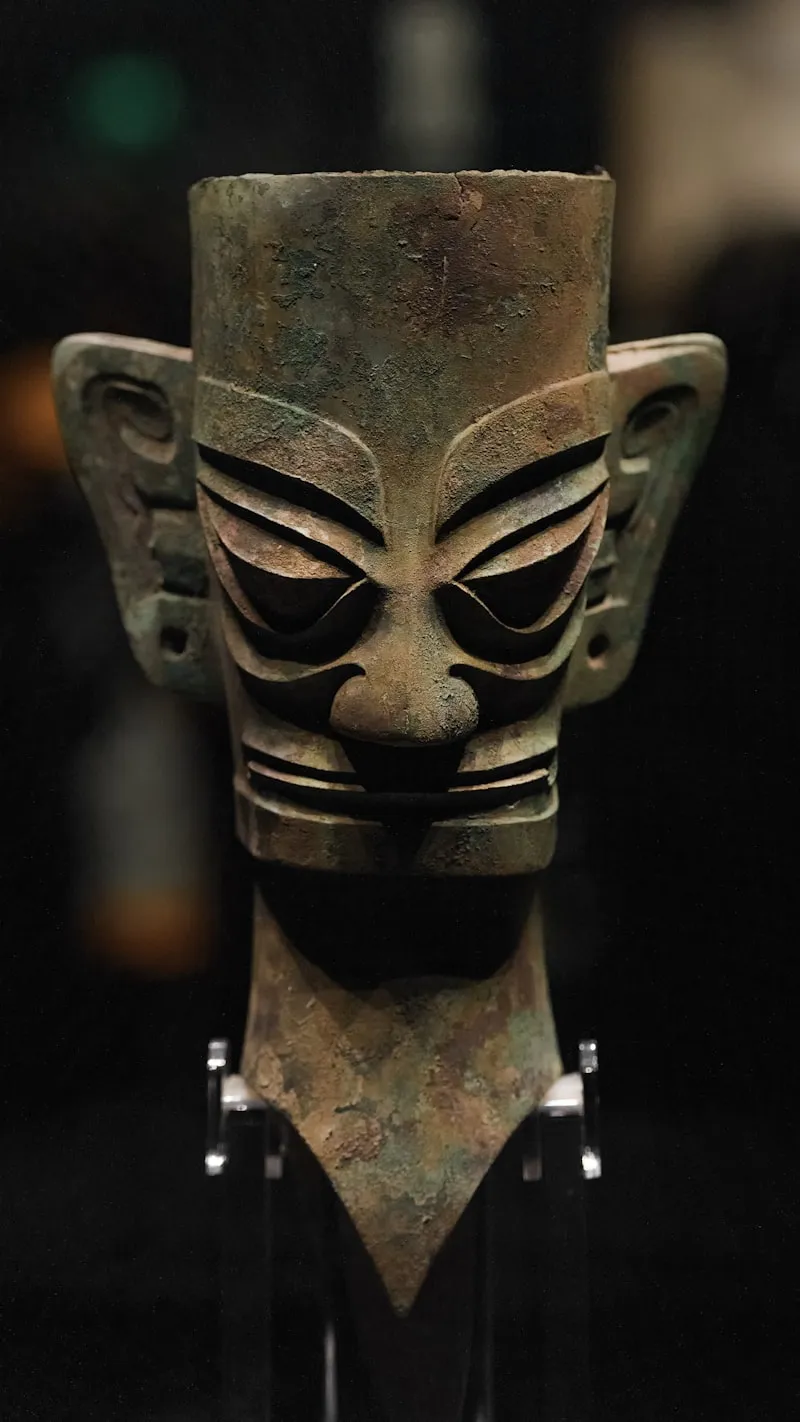
Shang builders worked primarily in timber and rammed earth, but their most distinctive architectural contribution was the integration of bronze. Bronze door fittings, hinge-posts, and ritual vessels were embedded in building foundations during consecration ceremonies.
The Shang also developed early roof tiles from fired clay, though these were reserved for the most important structures. Thatched roofs remained common for ordinary buildings, supported by timber posts set directly into rammed-earth foundation trenches. The most vivid evidence of Shang timber craft survives underground: the tomb of Queen Fu Hao, uncovered intact in 1976, preserves a two-story timber chamber whose mortise-and-tenon joinery already shows the full vocabulary of Chinese woodworking — proof that the nail-free tradition was fully formed by 1200 BCE.
The Yinxu site near Anyang preserves palace foundations, rammed-earth city walls, and the tomb of Fu Hao — a queen-general whose intact burial included a two-story timber chamber. The on-site museum displays excavated buildings, bronzes, and the only royal Shang tomb found unlooted.
Oracle bone inscriptions document construction rituals in detail: which day was auspicious for laying foundations, how many laborers to conscript, and the human and animal sacrifices offered to consecrate new palaces — evidence that building was inseparable from religion.
Hangtu is compacted in thin layers of soil, gravel, and lime — the densest construction material available before fired brick. Densely packed earth resists water erosion, and surviving Shang walls at Zhengzhou still rise several meters after three millennia.