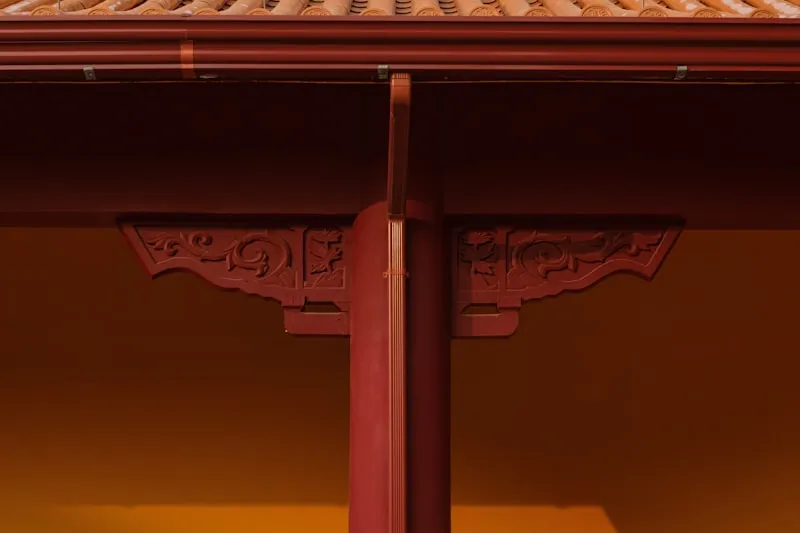
Refined elegance, intricate decorative brackets, and the first official building code.
Song dynasty architecture turned from Tang boldness toward refined elegance. Roofs grew steeper with more pronounced upward-curving eaves, and dougong brackets became smaller but far more intricate — sometimes purely decorative. The Yingzao Fashi, an official building manual published in 1103, standardized construction across the empire. Garden architecture flourished as an art form. Song cities broke from the rigid ward system of earlier dynasties, developing vibrant commercial streets lined with multi-story shops, restaurants, and entertainment venues.
In 1103, the Song government published the Yingzao Fashi (Treatise on Architectural Methods), the world's first state-issued building code. Compiled by the architect Li Jie, this comprehensive manual specified everything from timber sizing and joinery techniques to decorative painting and cost estimation — even down to the number of workmen required to move a given timber and the exact wages they were to be paid.
The Yingzao Fashi introduced the cai-fen modular system, where all building dimensions were derived from a standard timber cross-section measurement. This modular approach allowed prefabrication of components and standardized construction across the empire, yet permitted enough flexibility for regional variation and artistic expression. The manual's 34 chapters, with their detailed diagrams of brackets, beams, and roof framing, remained the definitive reference for Chinese builders for 800 years — and are still used today to authenticate and restore Song-era structures.
Song dynasty literati elevated garden design to a refined art form. Unlike the vast imperial hunting parks of earlier dynasties, Song gardens were intimate spaces designed for contemplation, poetry, and scholarly gatherings. Natural rock formations — often transported at great expense from distant mountains — were arranged to evoke mountain landscapes in miniature. Pavilions, covered walkways, and moon gates framed carefully composed views.
The Song garden was a setting for social performance as much as retreat: literati held poetry competitions in the pavilions, painted the views from the studios, and planted flowers by species whose meanings they traded in verse. The principles established in Song gardens — borrowed scenery (jiejing), the interplay of solid and void, and the seasonal transformation of plants — became foundational to Chinese garden design, and their fullest surviving expression can be seen in the Ming-Qing classical gardens of Suzhou.
Song cities abandoned the Tang ward system, allowing commercial activity to spill into the streets. Multi-story buildings lined commercial thoroughfares, with shops on the ground floor and residences or entertainment venues above.
The famous Qingming Shanghe Tu (Along the River During Qingming Festival) scroll painting, attributed to Zhang Zeduan, depicts the Song capital of Bianjing (Kaifeng) in exquisite detail: restaurants with elaborate signage, wine shops with decorative facades, and multi-story buildings of four or five floors — a built density unprecedented in Chinese urban history.
Compiled in 1103 by Li Jie, a Song court official, it is the world's first complete state building code — covering foundations, timber sizing, brackets, roofs, decoration, and even labor costs. It standardizes the cai-fen modular system and remains the key reference for restoring Song-era buildings.
Zhang Zeduan's Along the River During the Qingming Festival (12th century) is remarkably detailed and considered highly reliable: multi-story wine shops, bridge construction, shopfront signage, and street-life density all match contemporary texts. It is our richest visual source for Song commercial building.
Song literati — scholar-officials who valued poetry and retreat — built intimate gardens as settings for contemplation and gatherings. They perfected techniques like borrowed scenery (jiejing) and rock sculpture, establishing principles that reached their climax in Ming-Qing gardens such as Suzhou's classical ensemble.